
Hockney and freedom
Twelve years ago, in June 2014, Forest and Buckingham University Press hosted a talk by Professor John Staddon.
Professor Emeritus at Duke University in Durham, North Carolina, John had published more than 200 research papers and six books, and was the author of Unlucky Strike, Private Health and the Science, Law and Politics of Smoking, published in 2013.
Aside from such heretical views as ‘smoking is rarely treated fairly by politicians, health professionals or the public’ and ‘It puts individual smokers at risk. It does not put the public purse at risk’, Unlucky Strike stood out because it featured original illustrations by David Hockney with whom John was in correspondence. With his wife, he had even visited the artist in Yorkshire where they had been given a tour of his studio.
Following Hockney’s death last week I asked John if he would write a short tribute. He sent me the following:

David Hockney’s studio in Yorkshire. Photo by John Staddon
HOCKNEY AND FREEDOM
English artist David Hockney has just died at the age of 88. Born in Bradford, Yorkshire, he retained his north country habits as he cruised through Los Angeles and New York during the Andy Warhol/Pop Art years. Right now, a spectacular show of his recent work depicting the countryside near his Normandy home, is showing in London:
David Hockney has died, leaving London with the most visually seductive exhibition installation of the year as his obituary. A Year in Normandie is the most stunning I’ve seen since the National Gallery’s jewel-like Siena: The Rise of Painting. Entering the Serpentine’s North Gallery, you are plunged into darkness. The work consists of 130 paintings of views near Hockney’s home in Normandy, executed on an iPad.
Speaking of iPads, my interaction with Hockney began in 2012 or so. I was working on a book that aimed to correct the weak science and legal tricks that had been used to attack smokers. An old friend, an artist and smoker, knew about Hockney’s fight against anti-smoking disinformation and suggested I get in touch with him and see if he could help, which indeed he did.
My wife and I spent a great deal of time in York and while we were there David invited us to lunch at his mother’s house in Bridlington, on the Yorkshire coast.
Although I am a Hampshire man, I have many northern relatives. Hockney and I were born in the same year, which gave us more in common than might be expected. Wife and I had a great time as David toured us around his very large studio (above), complete with 3-D replicas of the gallery which was to host his upcoming show. He also showed us composite pictures taken with the aid of a jeep equipped with multiple cameras. He subsequently sent me several iPad pictures reflecting smoking-related nostalgia.
The book, complete with Hockney pictures and his Foreword (Staddon, J. Unlucky Strike: Private Health and the Science, Law and Politics of Smoking) was published by the University of Buckingham Press in 2013.
Unlucky Strike got a few nice reviews but there was nothing new from the medical establishment. Received wisdom was still represented by a 2005 Tobacco Advisory Group of the Royal College of Physicians report which highlighted claims such as: ‘ETS [environmental tobacco smoke] has been shown to cause lung cancer and ischaemic heart disease, and probably to cause COPD, asthma and stroke in adults. ETS is harmful to children, causing sudden infant death, pneumonia and bronchitis, asthma, respiratory symptoms and middle ear disease’. Also Sprach TAGRCP! Nicht so: ETS has not been shown to cause much of anything.
In response to this hyperbole I wrote a piece for my Psychology Today blog. This piece caught the attention of an experimental psychologist colleague, Alan Silberberg, at American University. I had not seen Alan for decades and had no idea he was interested in the smoking issue (we both studied learning in animals). It turned out that not only was he interested, but in 1999, more than a decade before my book, he had written several chapters of a carefully researched book on smoking. The book was not finished and it was never published. He sent me the manuscript, which was based on earlier data than my own book. Nevertheless, he came to essentially the same conclusions about health costs and the legal shenanigans that unjustly impacted smokers. It was an independent corroboration.
Alan Silberberg and I decided to publish an updated edition of my 2013 book with Alan’s chapters as an Appendix: Unlucky Strike, Second Edition. I sent a copy to David Hockney in Normandy, and he promptly noticed that I had (inadvertently) included an extra iPad picture of his (he had sent me a bunch – I was forgiven). Today, anti-smoking hysteria continues to the point that the UK’s unloved Labour Government, continuing a pattern of soft tyranny, proposes to abolish smoking entirely in a few years.
The received wisdom is (still!) that: (a) cigarettes kill almost 500,000 Americans per year; (b) second-hand smoke kills non-smokers; (c) cigarettes are addictive; (d) cigars, pipes and chewing tobacco are also substantial health threats; and (e) smoking imposes uncompensated costs on the American health system. In all these cases, weak science props up questionable conclusions. In all these cases, for various reason, the science has turned out to be shockingly simplistic, and in every case but one (the shortened life expectancy of heavy cigarette smokers) inconclusive or even false.
Smoking is a private, not a public issue. If the state can be induced to take its hands off smokers, iconic artist David Hockney will deserve much of the credit.
John Staddon
Professor Emeritus, Duke University
June 2026
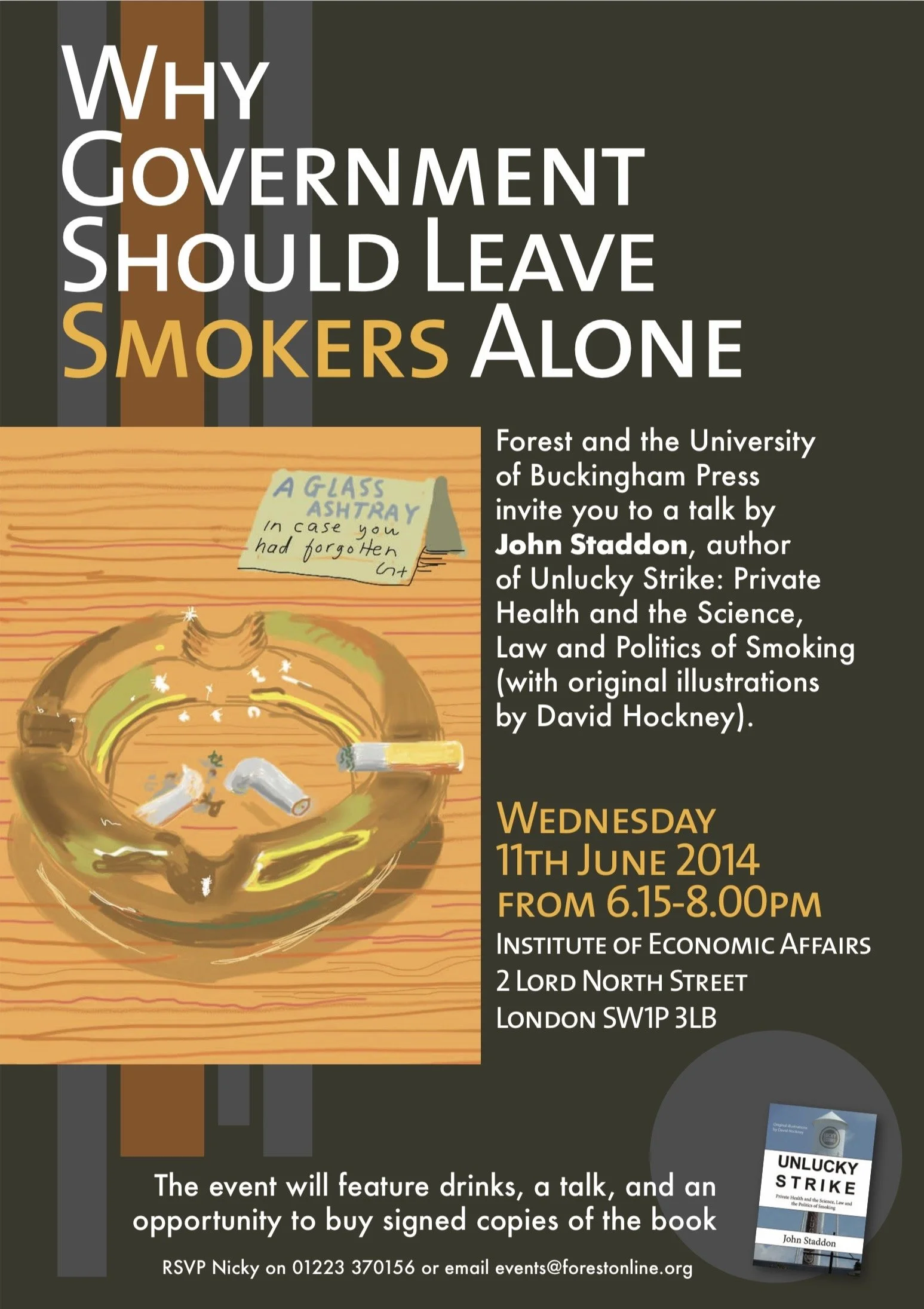
Flyer promoting our event with John Staddon in June 2014
