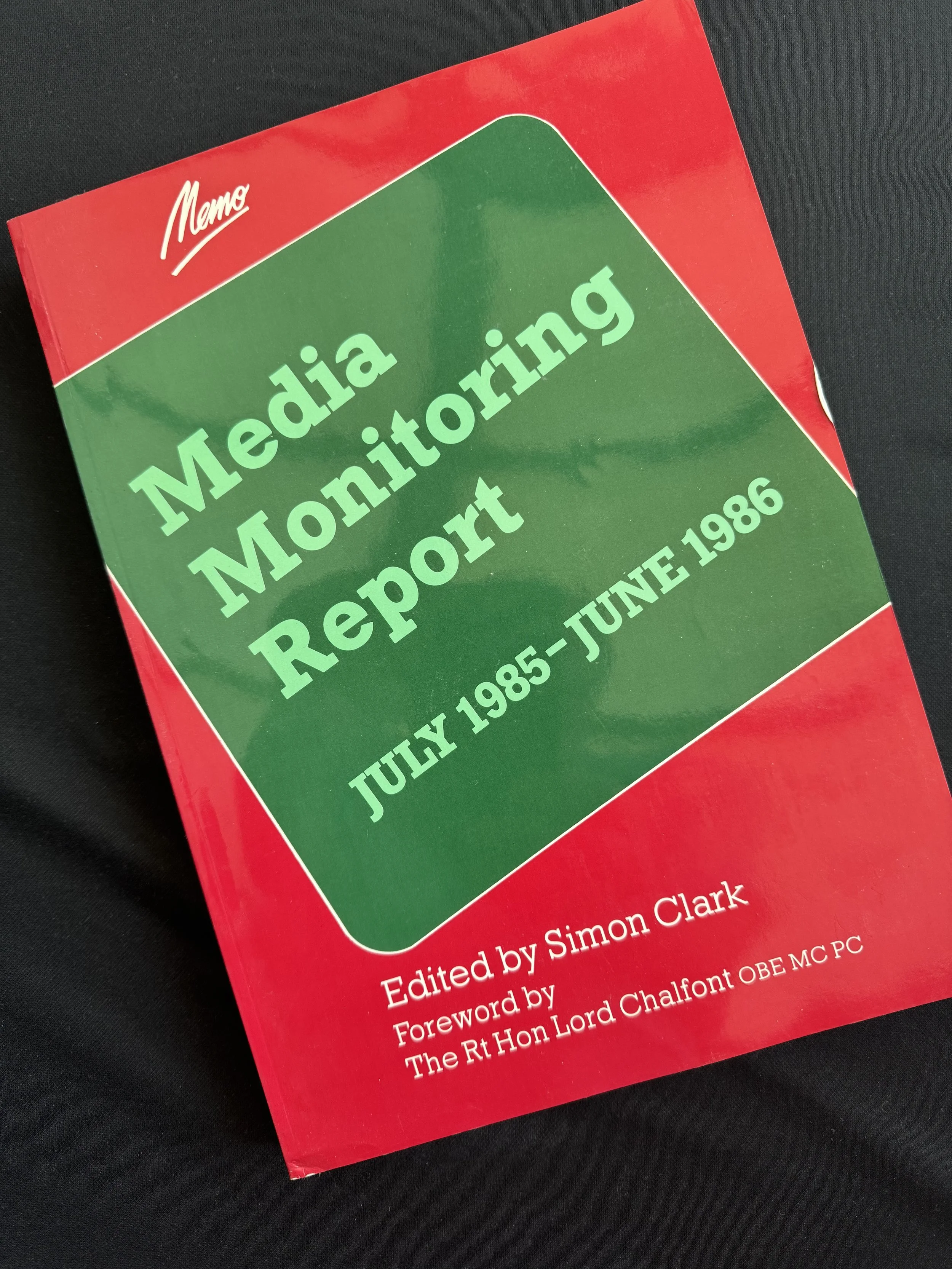
Forty years ago this week I published my first Media Monitoring Report.
As I’ve mentioned before, the Media Monitoring Unit was set up by Julian Lewis (now Sir Julian and the member of parliament for New Forest East since 1997) with the support of Lord Chalfont, a former Labour peer.
The aim was to highlight anti-government bias on television current affairs programmes because there was a strong feeling in the Eighties that TV news and current affairs programmes were significantly biased against the Thatcher government. Back then there were only four channels and programmes like Panorama (BBC1) and World In Action (ITV) were broadcast in prime time and had large audiences so they were considered far more influential than today’s current affairs programmes.
I was recruited by Julian, who I had known for a couple of years having met him when he was running an anti-CND group called the Coalition for Peace through Security (CPS). I was the sole MMU researcher and my job entailed spending hundreds of hours analysing scores of programmes before producing a detailed report.
I worked from home – initially a tiny basement flat in Ravenscourt Park near Chiswick – equipped with a 14-inch television, two video recorders (in case one failed to record the relevant programme), and an Apricot computer. I began work in July 1985 and the first report covered the 12-month period to June 1986.
Publication date was November 19, 1986, and the plan was to launch it at a press conference at the Oxford and Cambridge Club in Pall Mall. In those days there was no internet or digital resources so copies of the 314-page report, with an embargoed press release, were delivered by courier to every national newspaper a day or two in advance.
Unfortunately, the day before the press launch, the London Evening Standard broke the embargo and ran the story on its front page with a headline that screamed, ‘YES, THE BBC IS BIASED!’. Often, when an embargo is broken, it can kill a story because other newspapers will drop it. In this case it had the opposite effect and the following morning just about every national newspaper was running the story so we were delighted. The only problem was, what were we to do about the press conference that was still scheduled for 11.00am?
Given the obvious interest in the report we decided to go ahead with it and although most of the nationals (having already run the story) weren’t there, it was still reasonably well attended with interested observers including senior executives from the BBC, ITV and Channel 4.
I remember doing one or two interviews for BBC Radio, including the Jimmy Young Show on Radio 2, but the best thing to come out of the press conference was a full page feature in the Daily Telegraph written by reporter Maurice Weaver. Headlined ‘Pedigree of a TV watchdog’, it included comments by me and Julian plus a large photo of yours truly.
Over the next few years we published several more reports, each one attracting significant press coverage and the support of one or two influential journalists, notably The Spectator’s Paul Johnson who described our first report as a ‘real eye-opener’ before declaring:
This substantial document must be read in full by everyone in public life directly involved in the workings of the duopoly [BBC and Independent Broadcasting Authority], and especially by members of the IBA and the BBC Board of Governors. For MPs and journalists who feel they have not time to go through the whole thing, there is an admirable 15-page introduction, which summarises the first conclusions of the survey.
Others were less impressed and we also attracted some extremely hostile attacks, but I enjoyed that too because it meant our reports were getting noticed and having some impact.
Somehow we managed to give the impression that the MMU was a bigger operation than it was, but in 1990 the illusion was shattered somewhat when I was interviewed by a journalist from the Independent on Sunday for what turned out to be a four-page feature in the Saturday Review section. My mistake was to agree to be photographed at my house in Camberwell because en route I mentioned that in 1980 I had been interviewed but ultimately rejected by the BBC for a place on their graduate news trainee scheme.
The journalist was driving so I thought our conversation was off the record and made a joke of it, but my quip about that experience – including my response to the question “What do you know of Tibetan politics over the last 20 years?” (answer: “Not a lot”) – appeared on the front page of the paper under the headline ‘BBC's right-wing critic failed to secure trainee's job’. Ouch.
In truth, the MMU was beginning to run out steam by that stage and to an extent we had done our job because, for a while at least, broadcasters (the BBC in particular) were forced to take political impartiality (across a series of programmes) more seriously. I wasn’t unhappy therefore when the MMU came to an end because the work was quite boring and it was a fairly solitary existence. In fact, had I not had other work editing various magazines it would have driven me insane.
We went out with a bang though because my final project was commissioned by the Daily Express whose editor wanted me to monitor Radio 4’s Today programme over a random two week period and that report made headline news too.
Aside from the press coverage, there were other hugely satisfying moments and we annoyed a lot of people. In fact, we ruffled feathers so much that a conference in Manchester attended by 200 broadcasting executives devoted an entire session to the MMU and our ‘tireless propaganda’. The editor of World In Action, the late Ray Fitzwalter, even produced a video vilifying the MMU and demonstrating where I had got it ‘wrong’. Oddly enough, even though I was sharing a platform with him and had a front row seat, that was strangely satisfying too.
Anyway it’s 40 years since the publication of our first report (below). Where has the time gone?