
Mayo’s moment
Bit late to this because I was on holiday when it happened, but two weeks ago Mayo beat Kerry in the final of the All-Ireland Football Championship.
Unusually for a Gaelic football match, the result was reported around the world because Mayo’s victory marked the end of a 75-old-old ‘curse’ that had condemned the club to ‘decades of defeats’ including eleven losses in eleven finals. Also reported globally was the joyous outburst of emotion by two commentators on Midwest Radio (Commentators go absolutely ballistic for Mayo All-Ireland win).
Anyway, I was quickly notified of the result by my friend Bill who lives in Ireland and whose wife comes from Co Mayo, in the west of Ireland. He thought, rightly, that I’d be interested because it was through that connection that I watched Mayo play Fermanagh in the All-Ireland semi-finals at Croke Park in Dublin in August 2004.
The previous week our families had been on holiday together in Westport, Co Mayo, so there was no question who I wanted to win. Like the final, the semi-finals of the GAA All-Ireland Championships (football and hurling) are also played at Croke Park, and it was quite an occasion. If I remember, I went with Bill and his son, my own son Ruari, plus Bill’s sister-in-law and her husband who had travelled from Co Mayo to watch the match.
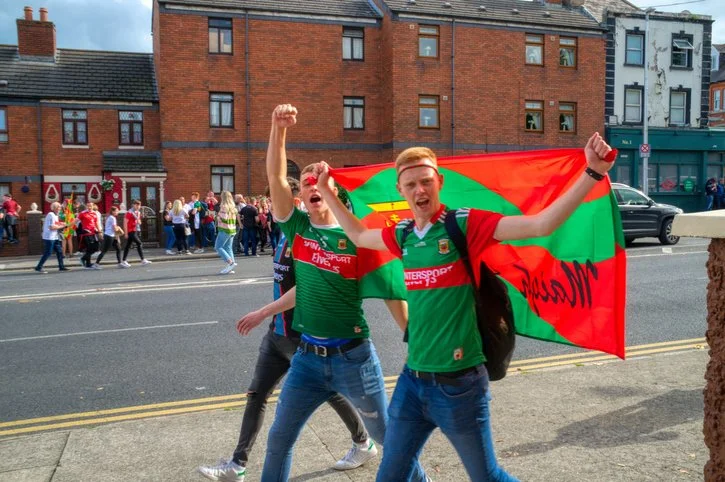
Mayo supporters in Dublin. Photo: iStock/ Frank Brennan
The 82,000 capacity stadium was full so there was a fantastic atmosphere, and although I got a bit confused with the scoring, I’m pretty sure the game ended in a draw and had to be replayed. (I’ve just checked and, yes, the teams drew and the match was replayed six days later. Mayo won that match but lost the final to Kerry, the team they beat two weeks ago.)
Fast forward to March 2011 and Ruari and I flew to Dublin to watch England get well beaten by Ireland in the final weekend of the Six Nations rugby. It didn’t affect the outcome of the tournament, which England had already won, but it denied them the grand slam and was therefore a bit of an anti-climax if you supported England. (The Irish seemed happy enough.)
The following day, with time on our hands before our return flight to Stansted in the evening, we went to Croke Park to watch Mayo play Dublin in an ‘Allianz Football League Division 1’ match played in front of a much smaller crowd, but I enjoyed it, even though I still didn’t fully understand the scoring system. For the record, Dublin (4-15) beat Mayo (3-13). RTE reported that Dublin ‘edged an extraordinary encounter’ but I don’t remember very much about the game apart from the subdued atmosphere which was a huge contrast with the tense All-Ireland semi-final we had witnessed in 2004.
What I do remember is that before the match Ruari bought a hurling stick (also known as a ‘hurl’ or ‘hurley’) and the taxi driver who drove us to the airport after the game was most impressed, unlike airport security who took one look at it and confiscated it on the grounds that it was an “offensive weapon".
For those of you unfamiliar with the game, hurling is similar to the Scottish sport of shinty, which in turn is a more barbaric form of hockey. For the best part of 150 years there has been a clear divide in Ireland between the GAA sports of hurling and Gaelic football, and the ‘English’ sports of rugby and (association) football.
Those cultural and political barriers still exist but in recent years they have slowly been eroded, partly because the English Premier League has a huge following in Ireland. However the most significant breakthrough arguably took place in the Noughties when the Irish Rugby Football Union (IRFU) was building the new Aviva Stadium on the site of the old Lansdowne Road ground in Dublin and the Gaelic Athletic Association (GAA) was persuaded to let them use Croke Park until the new stadium was completed.
Allowing England to play at the home of the GAA and Ireland’s Gaelic games was an historic moment because in 1920 Crown forces ‘stormed into Croke Park and opened fire on the crowd’ in reprisal for the killing of ‘six intelligence agents and two members of the British Auxiliary Force’ earlier that day.
Fourteen civilians including Tipperary footballer Michael Hogan died in the shooting and the Hogan Stand is a permanent reminder of ‘Bloody Sunday’. But that’s not all. Hill 16, the uncovered, all-standing terrace at one end of the ground, is named after the 1916 Easter Rising, so it was quite a moment when, on February 24, 2007, the England rugby union team ran out at this iconic venue.
As for Mayo finally beating the ‘curse’ to win the 2026 All-Ireland Football Championship, that was another historic occasion and, apart from Kerry supporters, I don’t think anyone begrudged them their moment.
Update: I’ve just read that Leeds will play Manchester United at Croke Park in a pre-season ‘friendly’ on Wednesday (August 12) and it will be the first time a club football match has ever taken place at the stadium.
Of all English clubs, Liverpool probably enjoy the most support in Ireland, but it does amuse me that Irish followers of the English Premier League, which includes clubs such as Manchester United and Leeds, will have watched the World Cup in the summer and supported ‘anyone but England’. What a strange relationship Ireland has with England.
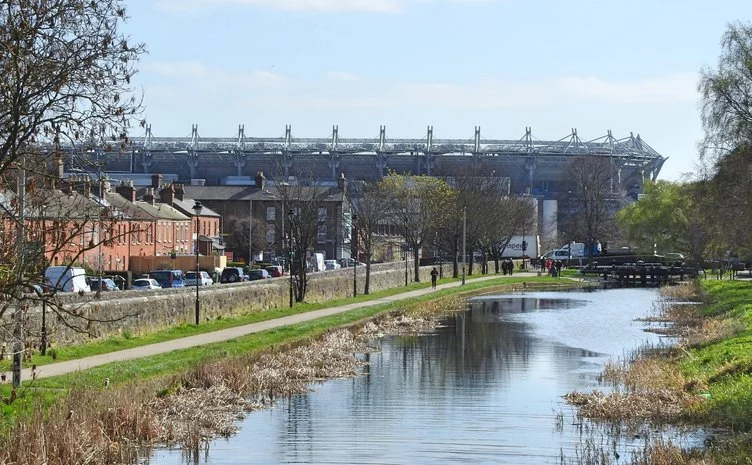
The Royal Canal with Croke Park stadium in the distance. Photo: iStock / Derick Hudson.
