Cultural vandalism
You may be aware that there is currently a ‘public’ consultation designed to elicit ‘views on proposals to regulate tobacco, vaping and nicotine products under the Tobacco and Vapes Act’.
The proposals cover:
packaging for some tobacco products, cigarette papers, herbal smoking products, heated tobacco devices and vaping and nicotine products
the appearance of heated tobacco devices and vapes
where shops can display herbal smoking products, cigarette papers, heated and other tobacco-related devices and vaping and nicotine products
As you might expect, vaping advocates have been vocal in their opposition to proposals that could result in further restrictions on the sale and marketing of vapes, and there are currently not one but two Save Vaping campaigns.
The first Save Vaping campaign was launched earlier this year, prior to a previous consultation (‘Smoke-free, heated tobacco-free and vape-free places in England’) that closed in May, and is credited to the New Nicotine Alliance. That campaign has since been tweaked to address the latest consultation, whilst a second Save Vaping campaign was launched this month by Riot Labs, an ‘award-winning e-liquid and smoking cessation company’. Both campaigns invite you to write to your MP and respond to the online consultation and if you are concerned by any of the proposals mentioned above I urge you to do the same.
That said, my sympathy for the ‘pro-vaping’ lobby is somewhat limited because I’m sick of the way many vaping activists have repeatedly thrown confirmed smokers under the bus, or done nothing to oppose anti-smoking policies such as plain packaging, bans on flavoured tobacco, or extensions to smoking bans. Their modus operandi is to maintain as much distance as they can from combustible tobacco, despite the fact that Forest has repeatedly warned vaping advocates and consumers that smokers are the canary in the coal mine and whatever fate awaits cigarettes will ultimately befall vapes and other nicotine products. This is because - as I have said many, many times - the eradication of smoking is not and never will be the endgame for the public health lobby, especially anti-smoking groups such as ASH.
Meanwhile the cigar trade is fighting a similar battle in defence of cigar smoking, highlighting the difference between the impact of smoking cigarettes and the occasional cigar on individual health, but I have rather more sympathy for their case because, in general, they are a lot less sanctimonious and holier-than-thou than many vaping advocates (and former smokers).
Cigar smokers can however be quite snobbish about cigars and, much as I liked him, I remember one very senior cigar advocate (now dead, sadly) taking a rather snooty view of cigarettes which I thought was a shame because, as far as Forest is concerned, we have never differentiated between cigarettes and cigars on the basis that, ultimately, what we are defending is the right to smoke tobacco, full stop.
By all means highlight the relative risks of cigarettes, cigars and other nicotine products, but if you truly believe in choice you surely must defend the consumption of each and every product. Failure to do so merely plays into the hands of the divide and conquer merchants whose tactics are very simple - eradicate cigarettes, then cigars, then other nicotine products (heated tobacco, vapes, pouches etc). Throw cigarette smokers to the wolves and you are merely advancing the moment when your preferred product will be targeted as well.
Anyway, until very recently the threat to cigars in the current consultation had gone slightly under the radar and it’s only now that people seem to be waking up to it. Last week the Telegraph reported that ‘Cigars face disappearing from Britain within a matter of years under “nanny state” health plans to make smoking less attractive’, and this week former Forest spokesman Brian Monteith argued that a ban on traditional cigar packaging would be ‘petty, patronising and pointless’.
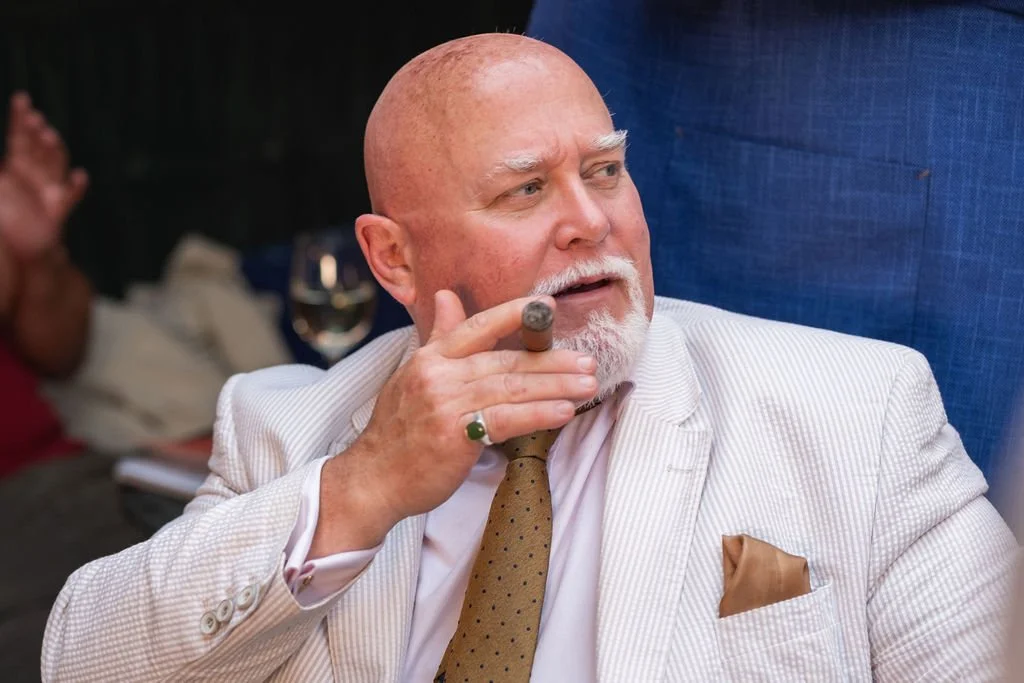
Brian Monteith
According to Brian (pictured above at a Forest event):
It is an existential threat to the specialist shops dotted around the country (even most large towns or cities cannot support more than one) because they will be forced – at their own expense – to repackage highly valuable existing stock. New boxes, wrappers and bands for every single cigar will need to be made and applied.
A similar point was made last weekend when Save Cigars campaigner Phil Buckthorpe spoke to presenter Dawn Neesom on GB News. According to Buckthorpe:
The problem is, the manufacturers and the distributors of the cigars are unlikely to continue to ship them to the UK if they have to do this repackaging.
So while people may think: 'I'll still get my cigars, they're just going to be packaged differently'. The reality is, a lot of the product lines won't make it to the UK anymore.
He also made the important point that cigars are hardly mentioned in the consultation document so there’s a good chance that many people will overlook what could be a serious threat to their existence in the UK. In short, this is prohibition by stealth.
Meanwhile Drum magazine has published an interesting and informative article (What happens when you put a $1,000 box of cigars in plain packaging?) that makes some pertinent observations including:
A cigar box is not only a piece of branding. Some identify the country and factory where the cigars were made, or when they were rolled or packed. Others help authenticate the box, trace its route through the supply chain or identify a particular maker or edition.
In other words, the sometimes elaborate (and undoubtedly attractive) packaging and banding on individual cigars is not just about marketing, it’s also about authentication and provenance. Remove that and not only do you eliminate vital information about a premium product, you also make it much easier for the counterfeiters and criminal gangs.
Furthermore, if the legal cigar trade is forced to adopt plain packaging exclusively for the UK market, why would they bother to export the product to these shores? And what will it mean for importers of cigars to the UK? Will the onus be on them to repackage the product so it meets the new regulations? Again, the opportunity for illicit traders to step into the breach will be enormous.
But there’s something else and it’s this. Many cigar boxes are genuine objects d’art. Some, it could be argued, are cultural artefacts - not ours, perhaps, but certainly countries such as Cuba and the Dominican Republic. Why should British politicians and the stop smoking brigade be allowed to desecrate another country’s culture?
Frankly, it’s a wanton attack on the countries and cultures from which most cigars are produced - that is, hand-rolled by skilled workers working on tobacco plantations.
And for what purpose? The percentage of UK adults who smoke cigars as their exclusive tobacco product is estimated to be 1.2% of the population, or 3.7% when including occasional or multi-product users (ie those who also smoke cigarettes and pipes). In numerical terms, that’s about 772,000 people. For many of them, cigar smoking is either a niche but pleasurable hobby or something they do to celebrate a special occasion. Either way, they are adults who don’t need to be molly-coddled by what Brian Monteith rightly calls the “bully state”.
Referring to all the ‘No Smoking’ signs that appeared following the introduction of the workplace smoking ban (including signage at the entrances to churches!), the late David Hockney talked about the “uglification of Britain”. Well, this attack on cigars is yet another example of what Hockney was talking about. First, cigarettes and rolled tobacco, now cigars … What next? Will everything that poses a potential risk to our health eventually be sold in standardised packaging to ‘deter’ consumers?
In 1981 I visited Moscow in the old Soviet Union. And do you know what? Not only was there a severe dearth of goods in the shops (including food), if I remember correctly many foodstuffs were sold in plain, non-branded packaging. That was communism for you and the contrast with our own supermarket shelves stacked high with brightly coloured tins and boxes was like night and day.
Incredibly, 65 years later, that appears to be the direction of travel in the UK too. It won’t happen overnight but it will creep up on us very slowly until, one day, older generations will look around and see what they’ve lost. And by then it will be too late.
See also: Labour’s cigar crackdown is a war on pleasure (UnHerd)
PS. The GB News interview with Phil Buckthorpe was the first time I had heard of Buckthorpe and his Save Cigars campaign and he came across as a decent chap, but I couldn’t believe it when he began his defence of cigars by saying:
The UK government passed a law in April called the Tobacco and Vapes Bill which … was essentially a generational ban … Anyone who was born on January 1st 2009 will never be able to purchase any tobacco product and most of us agree this is a good thing.
Seriously?
Why undermine the case for cigars by essentially supporting a generational ban that, by 2030, will see young adults prohibited from legally buying a cigar to celebrate their 21st birthday, not to mention the fact that in a further ten years even 30-year-olds will be denied the right to buy cigars.
Honestly, with ‘friends’ like that what hope is there for cigars or any other tobacco product?
PPS. The strapline for the Save Cigars campaign is ‘Plain Packaging, Plain Nonsense’. In 2014 Forest Ireland launched a campaign against plain packaging called Plain Packs, Plain Stupid. Perhaps we should revive it.

Cigar smokers (above and below) at Forest events. The war on cigars is a war on pleasure and aesthetics.