
Bridge over the River Tay
Today is the 60th anniversary of the opening of the Tay Road Bridge which connects Dundee to north east Fife.
Before the bridge was opened by the Queen Mother on August 18, 1966, there were three options. People could cross the river by train via the Tay Rail Bridge (opened in 1887); they could board one of the car/passenger ferries that ran from Dundee to Newport-on-Tay on the Fife side of the river; or they could travel by road via Perth, which added at least an hour to the journey.
The rail bridge crosses the river at Wormit where my family lived from 1969 to 1978. Now described as a ‘suburb’ of Newport, Wormit lies a mile west of its neighbour and from our house we could see the bridge stretching across the river, which is a mile wide at that point. In fact, there was hardly a day when I didn’t walk under one of the tall brick approach arches because our house was at the end of the narrow residential road that passed under the bridge.
The local tennis club, where I played tennis almost every day during the summer, overlooks the southern end of the bridge, and in the clubhouse there was (and probably still is) a framed photograph that was taken in May 1955 following a fatal train crash at Wormit station when members of the club rallied round to help the injured. (Three people were killed, 40 injured.)
As a teenager the rail bridge was therefore a constant background presence in my life, but it was the road bridge that had a far greater long-term impact because, had it not been open when we moved to Scotland in 1969, it’s very likely that my father would have bought a house on the other side of the river - specifically, in Broughty Ferry which is four miles east of Dundee, and had we moved to ‘The Ferry’ much of what followed (school, friends etc) would have been very different. I might even have developed a Dundonian accent.
Instead, the opening of the road bridge in 1966 encouraged an increasing number of people to move to Fife and commute by car to their workplace in Dundee, which is what my father did, and that’s how I ended up going to school in St Andrews instead of Dundee.
An immediate effect of the new crossing was the closure of the ferry service. According to reports, the final sailing took place at 6.30pm on the day the bridge opened. And that was followed, on May 5, 1969, by the closure of the railway station in Wormit, an occasion we missed by a matter of weeks because we didn’t move there until the end of that month.
Compared to the world famous Forth Bridge (rail) and the two road bridges that link Edinburgh with Fife, neither of the Tay bridges is what you might call a ‘looker’. The road bridge in particular is a rather bland concrete and steel structure with two narrow lanes either side of an even narrower central walkway that pedestrians have to share with cyclists. (It wasn’t always that way but I’ll come back to that in a minute.)
Nevertheless both bridges play an extremely important role in the region and if you know your railways you’ll know that the Tay rail crossing has an interesting, if tragic, history.
The original single track bridge opened on June 1, 1878, and a few weeks later Queen Victoria gave it her seal of approval when she crossed the river by train en route to Edinburgh from Balmoral. However, in December 1879, less than 18 months later, the central section collapsed while a train was crossing the bridge during a storm, and all 75 passengers and crew were killed.
The following year, the designer, railway engineer Sir Thomas Bouch, who had been knighted by the Queen the previous year, died, aged 58. An enquiry into the Tay Bridge disaster had blamed Bouch for the collapse of the bridge and his health quickly deteriorated. Some said he died of a ‘broken heart’.
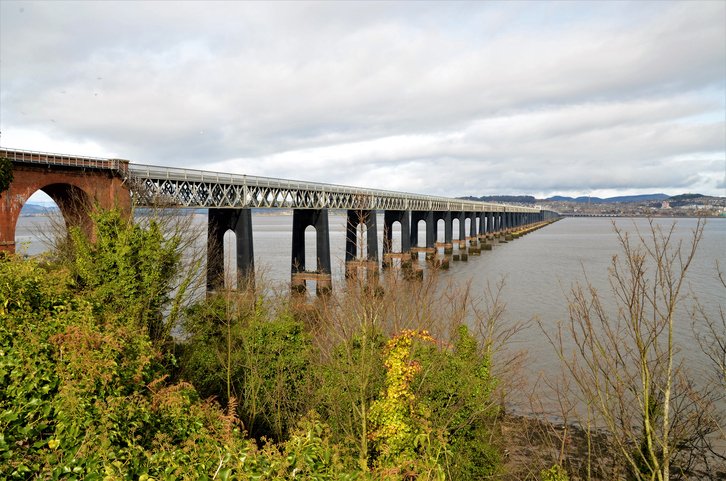
View of the Tay Rail Bridge from Wormit. Note the stumps from the original single track bridge that collapsed in a storm in December 1879. Credit: iStock / alanfinn
The current double-track bridge, which sits parallel to the original bridge (you can still see the stumps where the first bridge stood), took four years to build and was opened in 1887. At the time it was the longest bridge in the world but that is arguably its only claim to fame. I’ve seen it described it as a ‘straightforward pier-and-lattice girder bridge’ that ‘lacks any distinguishing characteristics’, which is a bit harsh. Unlike its short-lived predecessor, however, it’s still standing and is in constant daily use as part of the mainline rail network.
Arguably, the Tay Road Bridge has even fewer characteristics. It does however have its own grim record of fatalities, albeit nothing as dramatic as the original rail bridge. However, I understand there’s a team that monitors unusual activity on the bridge 24/7 and from what I’ve heard you would be surprised how often their expertise is required to talk vulnerable people from jumping off and taking their own life.
Anyway, my only other Tay bridge-related story concerns the day my parents took me to a bicycle shop in Dundee to buy me a brand new racing bike. (That is, a proper bike, not like the awful Chopper that was fashionable in the early Seventies, although I can’t say I knew anyone who had one.)
I was eleven at the time and what happened next may appear, from the standpoint of 2026, a bit irresponsible but at the time no-one, least of all my parents, gave it a second thought, so let me explain. First, my new bike was chosen on the basis that I would ‘grow into it’. In practise it meant that, even with the saddle at its lowest setting, my toes barely touched the ground which meant that stopping was, initially, a little hazardous because it was difficult to put my foot down to steady myself.
Despite that, there was no alternative but to cycle from the bike shop in Dundee to our home in Wormit, a distance of five miles that included one of the longest road bridges in Europe with no cycleway, just two narrow lanes I had to share with cars and the occasional lorry. To be fair, the bridge was far less busy than it is today, and it was a Saturday so probably less busy than during the week. In fact, when it opened in 1966 daily traffic averaged between 3,000 and 5,000 vehicles a day, quickly rising to 6,000. Today, the figure is around 26,000, which is one reason why cyclists are no longer permitted to ride on the road and instead have to share the central walkway with pedestrians.
Nevertheless, I made it home safely (without stopping!) and since that day I’ve crossed the Tay Road Bridge hundreds of times, albeit never on a bike (once was enough). I remember walking across it once (just so I could say I’d done it), but when I was a teenager I was usually on a single decker bus. Later, after I passed my driving test, I would drive my mother’s car, stopping at the toll booth on the north side of the bridge to pay the toll.
In 1966, when the bridge opened, cars were charged half a crown (two shillings and sixpence or 12½p), motor cycles cost one shilling (10p), and heavy goods vehicles cost ten shillings (50p). By 2008, when the SNP government scrapped the tolls on the Forth and Tay bridges, cars were charged 80p, buses £1.40, and heavy goods vehicles £2.
Which brings me to the present and, yes, I still drive across the bridge multiple times a year. Remarkably, a crossing that was three-years-old when my family moved to Scotland is now 60. How time has flown. Happy birthday, Tay Road Bridge!
Update: I have just read that ‘when the bridge first opened under 14s were not allowed on the bridge unless accompanied by an adult’. Apparently this was one of many by-laws that were introduced when the bridge opened in 1966 and was still in existence as late as 2023 when the by-laws were updated.
The original by-law referred specifically to pedestrians on the central walkway. In contrast there appears to have been no restriction on anyone, including eleven-year-olds, riding their bikes, unaccompanied, on the vehicle lanes, a practise that today is illegal regardless of the age of the cyclist!
PS. The Severn Bridge, which extended the M4 motorway from England to South Wales, also opened in 1966. Other milestones during that famous year included:
The first cross-channel hovercraft was introduced, taking half as long as the existing ferries.
Longleat Safari Park opened, becoming the first drive-through safari park outside Africa.
Barclays launched the Barclaycard - the first all-purpose credit card to be issued by a British bank.
Glasgow airport was officially opened by Queen Elizabeth II.
See: 66 reasons why 1966 was a great year for Britain (BBC News)
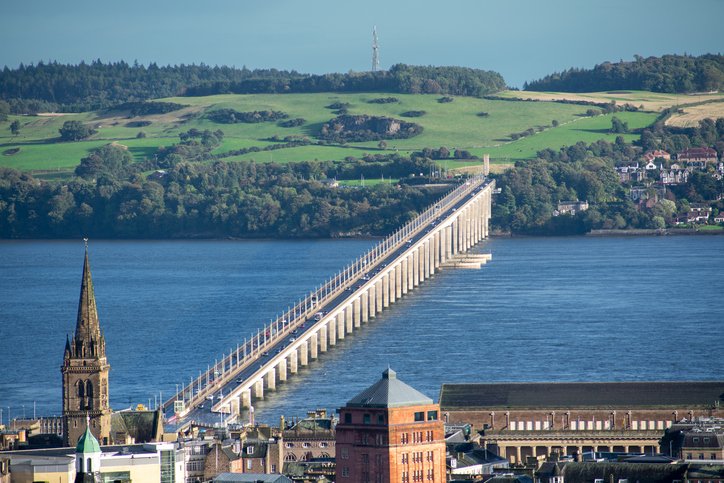
The Tay Road Bridge looking across to Newport-on-Tay. Note that the bridge is higher on the Fife side. Credit iStock / Jamie Ballantine
