Sleepwalking to prohibition
Back from the World Nicotine Congress in Brussels.
A brief recap. The WNC is the brainchild of Elise Rasmussen who founded the Global Tobacco Network Forum in 2008 before renaming it the Global Tobacco and Nicotine Forum (GTNF).
Thanks to Elise, who I first met at a Forest event at Boisdale in 2008, I’ve spoken at GTNF conferences in Bangalore, Cape Town, and White Sulphur Springs in West Virginia, as well as Bologna, Antwerp, New York, and Washington DC.
Anyway, on the same day it was announced that Elise was leaving GTNF, after 17 years, she revealed her new project. That was in November so to organise a similar event, albeit on a smaller scale, within four months is pretty impressive.
As its name suggests, the World Nicotine Congress attracted delegates and speakers from all over the world including India, Australia, the United States, and Europe. Over the three days I didn’t attend every session but the agenda was much as I expected, with tobacco harm reduction the dominant theme.
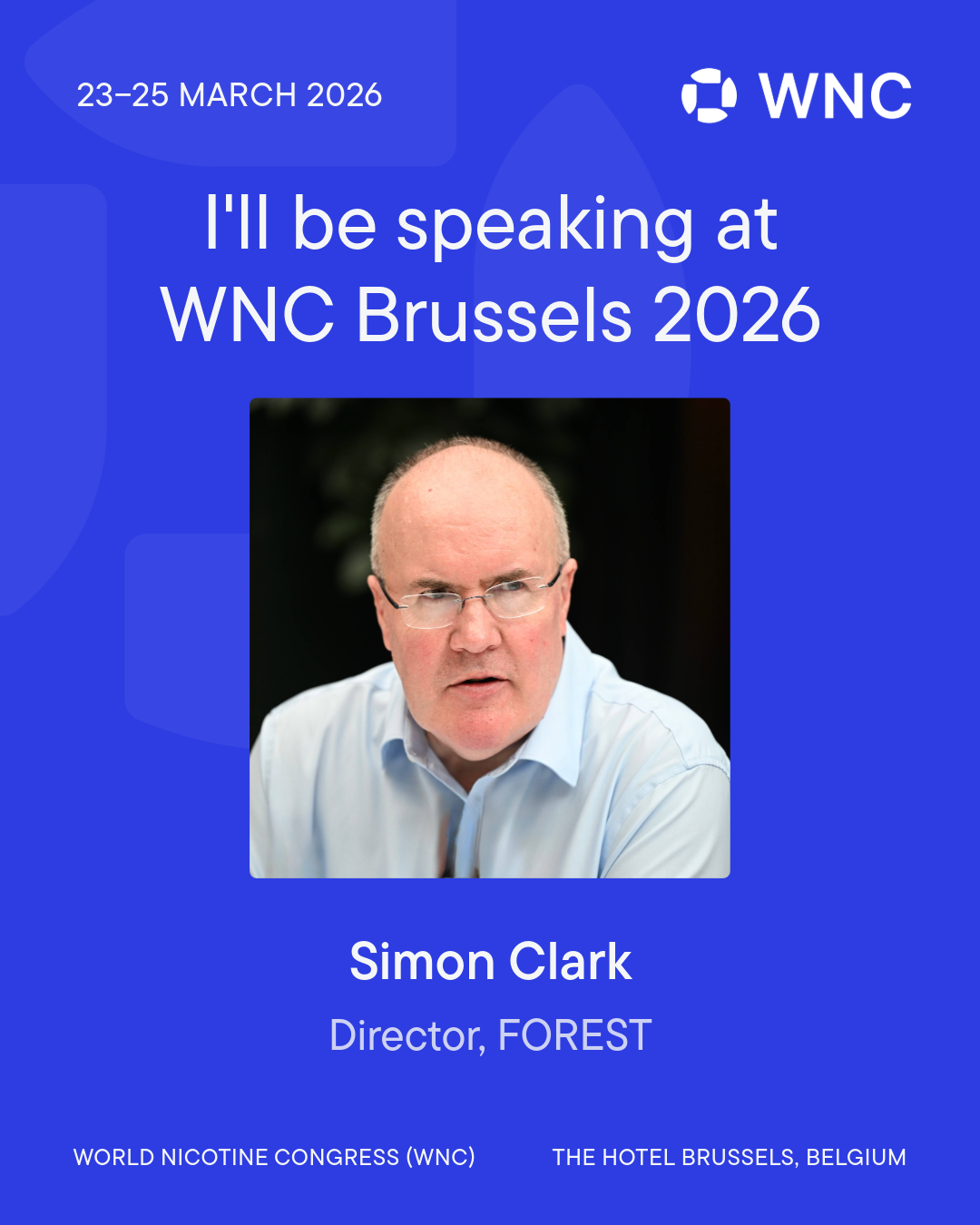
Elise had invited me to be on a panel of speakers during an evening drinks reception that followed the main programme on Monday. I think we were all a bit dubious about the format because addressing an audience at the end of a long day and, worse, when they are on their feet drinking, isn’t ideal. In my experience the only thing you can do in that situation is speak loudly and limit your comments to a handful of soundbites in the hope that one or two points will register with guests who may be on their second or third drink by the time you open your mouth.
To be fair, it wasn’t too bad, although a similar session the following evening worked better, I thought, because the audience was seated at tables and under strict instruction not to talk. Also there was a clearer theme and fewer people on the panel. (On Monday I had to share the stage with a moderator and four other speakers including Clive Bates, the former director of ASH who is now a leading THR and vaping advocate.)
For me, the pick of the keynote speakers was Roger Bate, president of the Center for Global Health Accountability, who gave an interesting virtual speech from his home in America until the connection was lost. There were arguably too many speakers (five or six) on most panels which limited their impact, but if I have a (small) criticism – which may be connected – it concerns the lack of time for Q&As.
I was frustrated, for example, not to have the opportunity to ask a question of a panel that featured representatives from JTI, Imperial Brands, and BAT. The session was called ‘The Industry Perspective: Real World Evidence’ and I wanted to address the fact that governments, public health and even the tobacco industry can be very selective when it comes to reviewing or even acknowledging real world evidence if it doesn’t suit their agenda.
This includes evidence that many people enjoy smoking and don’t want to quit. Ten years ago Forest commissioned a report by the Centre for Substance Use Research (The Pleasure of Smoking: The views of confirmed smokers) that was ignored by almost everyone, so my question was going to be something along the lines of, ‘Can you offer an assurance that real world evidence from confirmed smokers is not being ignored by the tobacco industry?’.
Instead I was beaten to the microphone by Clive Bates who wanted to make a statement about something completely different, and the opportunity was gone. My fault. I should have been pushier, but more time for Q&As would have helped.
I missed the final session (‘Key Takeaways’) because I had a train to catch, but my key takeaway of a largely successful and well organised event is that conferences like this must not become an echo chamber, like the Global Forum for Nicotine, for example, which I have written about several times including here (2019) and here (2022).
It’s not easy, of course, because I do understand that opponents of the tobacco industry are generally unwilling to engage. Nevertheless, listening to the same stats about the success of THR in Sweden, Greece and New Zealand does get a bit repetitive when you’ve heard them from umpteen different speakers.
THR is great, I geddit. But it would be nice too to hear from smokers who enjoy the habit, not just former smokers who have switched to reduced risk products. Instead, as is the norm now, the ‘Consumer Panel’ session featured two representatives from the Coalition of Asia Pacific Tobacco Harm Reduction Advocates (CAPHRA) and one from Rights4Vapers (a Canadian group), but not a single confirmed smoker.
Most of all, I genuinely don’t understand why the tobacco sales ban - which is being imposed on all future generations of adults in the UK from January 1, 2027 - was not on the WNC agenda. Yes, I brought it up in our evening session on Monday when I highlighted it as yet another instance of creeping prohibition. I even warned of the long-term threat to vaping because it creates the perfect template for other nicotine products, regardless of the relative risk.
“We’re sleepwalking to prohibition,” I said. But is anyone listening?