Allan Massie: novelist and journalist, 1938-2026
“I fear that resisting the McNanny State is a bit like trying to push the Atlantic back with a stable brush. But one has to keep trying.”
I’m sorry to hear that novelist and journalist Allan Massie has died. I only met him once, in 2018, but it was a big occasion (for me if not for him!) because he was our special guest at a private dinner at the National Museum of Scotland.
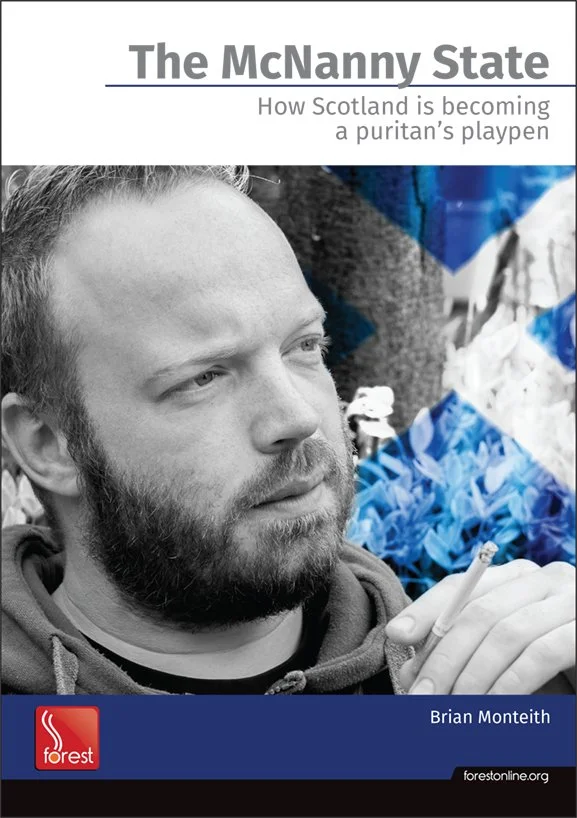
Our principal speaker was Brian Monteith, a former spokesman for Forest in Scotland and a member of the Scottish Parliament from 1999-2007. Brian had written a report, ‘The McNanny State: How Scotland is becoming a puritan's playpen’, and had persuaded Allan to write the foreword (see below).
Getting Allan to the dinner in Edinburgh was arguably more difficult because he was 79 at the time and we had to hire a car (and driver) to pick him up and return him to his home in Selkirk, in the Borders, a round trip of almost 90 miles. It was worth it, though, because he brought a quiet gravitas and a knowledge of Scottish history that were unique to him that evening. After the event, which was attended by 15 other guests, he wrote:
There was an interesting division between those who, understandably, and wanted to talk about the impact of government policies on their own line of business, and those who were more concerned with the political-philosophical questions.”
Pessimistically, he added:
I fear that resisting the McNanny State is a bit like trying to push the Atlantic back with a stable brush. But one has to keep trying.
Amid the many tributes and obituaries, his son Alex (a well-known journalist in Scotland and a regular contributor to The Spectator for many years) has written a lovely piece here. Do read it. The comments below the article also demonstrate the esteem in which his father was held, even by people who may not have shared his (soft) centre-right politics.
Alex doesn’t shy away from his father’s issues with alcohol, which I was unaware of (he appears to have given up drinking many years ago following a period in rehab), adding:
Tobacco, on the other hand, remained a faithful and reliable friend. I think he must have smoked a million cigarettes and lord-knows-how-many cigars. Filterless Gitanes and filthy Toscano cigars, since you ask. He had his last cigar less than a fortnight ago and although he had by that stage become something of a fire-raising risk, I wish he could have occasion to smoke one more.
Which reminds me, when Brian asked Alex’s father to write the foreword to The McNanny State, the author of critically acclaimed novels such as Augustus (1986), A Question of Loyalties (1989), and The Ragged Lion (1994) accepted not money but 200 Gitanes sans filtre, an arrangement that seemed to please everyone, not least the happy recipient.
Allan Johnstone Massie: 1938-2026
See also: Forest’s night at the museum

ALLAN MASSIE’S FOREWORD TO THE McNANNY STATE (2018)
WRITING OF HIS TIME as a Conservative and Unionist parliamentary candidate before 1914, John Buchan remembered that while Tories were better-born, the Liberals were sure they were born better. As Brian Monteith demonstrates in this masterly survey of the almost twenty years of devolved government in Scotland, we are now in the grip of a political class that is complacently certain of its moral or ethical superiority, a class that in its ineffable conceit has no doubt that it knows what is good for us, and does not hesitate to legislate accordingly. The Church of Scotland and the Roman Catholic Church in Scotland may have lost much of their old authority, but that authority has been transferred to the political class, or been annexed by its members. Scotland today is governed by men and women belonging to the class of beings whom Robert Burns resented and mocked as the “unco’ gude”. Ever since the Scottish Parliament came into being in 1999, the politicians have chipped away at the liberties of the people.
Brian Monteith calls Scotland today a McNanny State. Fair enough, you may say, for we have a state where the politicians , like Nanny, know what is best for us and are determined to teach us good behaviour. Yet the term is unfair to Nanny. A good Nanny prepared the children in her care to grow up, to be free of her, to become eventually responsible young adults. The Scottish state today treats adults as people incapable of managing their own lives and, if they are parents, as people who cannot be trusted with the unfettered care of their children. So it’s not a Nanny, or McNanny, State. It’s more like a soft fascist one: soft because there is no violence or brutality, no castor oil or camps for delinquents; yet fascist because the logic of its policies is that politicians are the masters, not the servants of the people, while the people must be pressed into a way of life as approved by the “unco’ gude”.
Like hard big-F Fascist states, our soft small-f fascist one recognizes the family as a subversive force, potentially subversive at any rate. So children are first fed, as Monteith reports, with propaganda that will render them critical of their parents, a policy pursued by the Fascists in Italy, Germany, and the nominally Communist Soviet Union. Next, our Scottish Government made its resentment and distrust of the family explicit by introducing its proposal that every child should have a state-appointed Guardian, a “named person” responsible for overseeing the child’s welfare from birth to adulthood.
Opposition has seen the plan somewhat diluted and its implementation delayed. You would however have to be a trusting innocent not to realize that once the proposal has been enacted, then the ”ratchet-effect”, as seen, and so well described by Monteith, in the operation of anti-smoking and anti-drink legislation, will begin; restrictions on parental rights will be tightened and the power of the named person and the State will be extended.
Robert Burns used laughter as a weapon against the unco’ gude - see “Holy Willie’s Prayer”. We ought likewise to mock the self-righteousness of today’s Holy Willies, and expose their hypocrisy. One example – a small but significant one – is the readiness to grant charitable status to a political pressure group like ASHScotland. This body, formed to lobby against the tobacco industry and, by extension, with the purpose of restricting the freedom to smoke, gets the bulk of its income from taxpayers. The smokers it persecutes are taxpayers, disproportionately highly taxed ones indeed. So they are compelled to finance an organization that harasses them. Before Hitler came to power, Brownshirted members of the SA used to thrust collecting-boxes at people in the streets demanding a contribution . Things are arranged more doucely in Scotland. There’s no need for the zealots of Ash Scotland to jiggle collecting-boxes on flag days.
Politicians can always find good reasons to curtail liberties, invoking the General Interest, as they do so. In this the Scottish Government is no worse than others. But it is still bad. Brian Monteith’s examination of the consequences of devolving power to Holyrood is measured – more measured than this indignant foreword - and cogent. He recognizes more clearly than most that the extension of government is always presented first as a boon and blessing, and time may pass before it is felt as a burden and a curse.
He calls for action. I hope, without much confidence, that it is not too late for his call to be answered, and we elect politicians who respect inherited liberties and speak up for the common sense of people, and against the prejudices of the Unco’ Gude.
Allan Massie, foreword to The McNanny State, June 2018