
Who reads Private Eye in 2026?
Private Eye celebrated two milestones recently - the magazine’s 65th birthday and the 40th anniversary of Ian Hislop’s tenure as editor.
I’m the last person who should criticise someone for staying in the same job for decades, but it does seem a bit odd that a magazine that was founded in 1961 to mock and hold to account the post war Establishment is edited by someone who, in 2026, comes across as a rather obvious member of our current ruling ‘elite’, a self-confessed “remoaner” whose vocal opposition to Brexit demonstrates how out of touch he is with many ‘ordinary’ people.
I’ve never met Hislop but I must declare an interest because in the 1970s I was a huge fan of Private Eye, which in those days was edited by Richard Ingrams. At university I even co-edited a student magazine, Campus, that was not only inspired by the Eye, it was our template. When we were sued for defamation it felt like a badge of honour that we shared with the Eye. For a while it was even a vague ambition of mine to work for the magazine, so when I launched a national version of Campus in 1983 I was delighted when an opportunity arose to contribute to the Eye.
Going on memory, what happened was this. Shortly after our plans for Campus were reported by the Sunday Times and the London Evening Standard, I was contacted by a journalist who worked for the Eye and after we met at the Coach and Horses pub in Soho (where the magazine hosted their famous fortnightly lunches) I was invited to contribute stories to the magazine’s HP Sauce column.
Together with Peter Young, founder of Campus at Aberdeen University in 1978, and chairman of the Federation of Conservative Students from 1980-1981, I submitted a succession of stories that were published, largely unedited, in multiple issues of the Eye over several months. (As an aside, Max Young, Peter’s son, is the news editor at Guido Fawkes, so a nose for political news and gossip must run in the family.)
Private Eye was still edited by Ingrams at the time and I hoped that by contributing stories I might meet him. (Famously, he gave Hislop a job after the latter interviewed him when the Eye’s future editor was still at Oxford and editing a magazine called Passing Wind.) That was the carrot but I never met Ingrams because my contact - who shall remain nameless - failed to make good on what I thought was the promise of an introduction. For that and other reasons, including the fact that Peter and I felt we were being significantly underpaid for what we were contributing, we walked away and that was that.
As it happens, the journalist was a friend of Hislop (they had been at Oxford together) and it was clear, even then, that Hislop was the prime candidate to replace Ingrams as editor. Whether it’s true or not I don’t know, but I was told that Hislop had seen Campus and didn’t like it, so that didn’t help!
Credit: iStock/ zodebala
Anyway, in 1986 Hislop was appointed editor with a plan, I believe, to reduce the substantial financial losses the Eye had previously suffered fighting countless legal battles. I assume that included taking fewer editorial risks, settling out of court (which avoids much larger legal bills) when necessary, and so on.
The downside, for me as a reader, was that it made the magazine far less interesting and addictive to read because before that I felt I had to buy every issue to keep up with ongoing stories about specific people, not to mention the legal battles the magazine found itself engaged in (which were often entertaining).
Plaintiffs like James Goldsmith who inspired the famous Goldenballs campaign became well-loved hate figures (if that’s not an oxymoron) and as a reader I wanted to follow such stories to their conclusion. I completely understood the need to reduce the magazine’s exposure to financial risk or worse, but for me the Eye lost much of its edge and appeal and I gradually lost interest and stopped buying it. I can’t have been alone but, to be fair, the magazine has enjoyed a remarkably successful second life under Hislop, attracting new readers and more than doubling its earlier circulation.
Nevertheless the Eye’s lasting success is a mystery to me. As a teenager and well into my twenties I bought it religiously every fortnight. Initially I was a subscriber but when I graduated and moved to London I was so keen to be one of the first to read the next issue that I stopped subscribing so I could buy it from a newsagent as soon as it came out on Thursday rather than waiting for it to be delivered by post on Saturday. However, the copy I purchased at Waitrose (!) last week is the first I’ve bought, and read, for at least 25 years.
Prior to that the last time a bought a copy was probably in 1999, shortly after I started working for Forest, and the only reason I bought it then is because someone from the Eye called and said they were going to write a piece about my appointment and he wanted to check some facts. Naturally I was flattered and bought the next issue to see what had been written, but there was no mention of me or Forest! On one hand I was slightly relieved because I didn’t know how our donors would react, but I was also disappointed because I thought my appointment deserved a couple of column inches at least!
Since then the only other contact I’ve had with the Eye was in 2004 when Forest was campaigning against the proposed smoking ban. We couldn’t afford to place ads in national newspapers so we focussed instead on a handful of news and current affairs magazines - namely The Spectator, New Statesman, The Week, and Private Eye. However, one publication refused to accept our ads and that was the Eye. The decision, furthermore, came not from the advertising team but from the editorial side.
I understand it was based on a wish to remain politically neutral, and the smoking ban was considered a political issue. It did however lead to my one and only visit to the Eye’s office at 6 Carlisle Street, Soho. Hislop wasn’t there but at least I finally got my foot in the door.
Today I genuinely don’t know a single person who reads the magazine. According to the Eye’s media pack, however, it has a circulation of 225,642 (Jul-Dec 2025), ‘100% actively purchased’, and a readership of 1.1 million which is significantly more than the print editions of many national newspapers. Significantly, 79% of readers are ‘white-collar professionals with disposable income’, but it still doesn’t fully explain who is reading the magazine in 2026 because a great many people of my generation, especially those on the centre right, have surely outgrown or given up on it (or so you would think), and my own children - now young adults - have never shown the slightest interest in it. Likewise it’s a long time since anyone in my circles - social and professional - have mentioned the magazine.
I’m guessing that the Eye’s longevity may owe something to Hislop’s 36 years on Have I Got News For You, another long-running institution that, remarkably, continues to be watched by up to 4.5 million people every week. It’s incomprehensible, to me, that a programme whose best moments were a quarter of a century ago still attracts such a large audience, but there you go. The figures don’t lie and as a result the team captains - Hislop and Paul Merton - have arguably become national treasures (of a sort).
Likewise, by association, Private Eye. I haven’t watched HIGNFY for years, but when I did I don’t recall the magazine ever being mentioned (which was probably deliberate), but most viewers must be aware of Hislop’s day job so it’s not a huge leap to think that his presence on prime time TV has indirectly benefitted the magazine.
Reading the current issue after so long away was a strange experience. In many ways little has changed, notably the design which has barely altered since the Seventies when I first discovered the magazine. The cheap aesthetic was always part of the Eye’s appeal because it stood out from the glossy magazines on the newsstands and looked more like a fanzine. To these ageing eyes however it’s uncomfortable to read because the text is small and looks quite dense on the page.
Many of the old features are present and correct, including HP Sauce, Nooks and Corners, Rotten Boroughs, and Pseuds Corner. Colemanballs is still there too, although it’s been rechristened Commentatorsballs which is a more literal description but if the Eye can retain the name Street of Shame long after the last newspaper left Fleet Street I think it could have retained its affectionate reference to the late but great David Coleman.
If there’s one obvious difference it’s the number of pages that are devoted to advertising, because there seems to be significantly more than I remember, although that may wax and wane during the year. There appear to be more editorial pages too, especially in the news and current affairs section - too many, in my opinion, because it felt far too much of a chore to read every page and every section, so I didn’t.
Anyway, it’s over 40 years since I naively told a Sunday Times reporter that if the national version of Campus was a success we intended to build on it and launch a rival to Private Eye that would be published on alternate weeks to avoid a direct clash. That was the intention, at least. No prizes for guessing what happened. Banned by 40 student unions because of our opposition to the National Union of Students, Campus fizzled out after two years and our proposed rival to the Eye never saw the light of day. Ah well, I was always better at publicity than business.
See How Private Eye lost its bite: the magazine is too cosy with the new liberal Establishment (UnHerd). Written in 2019 but still relevant.
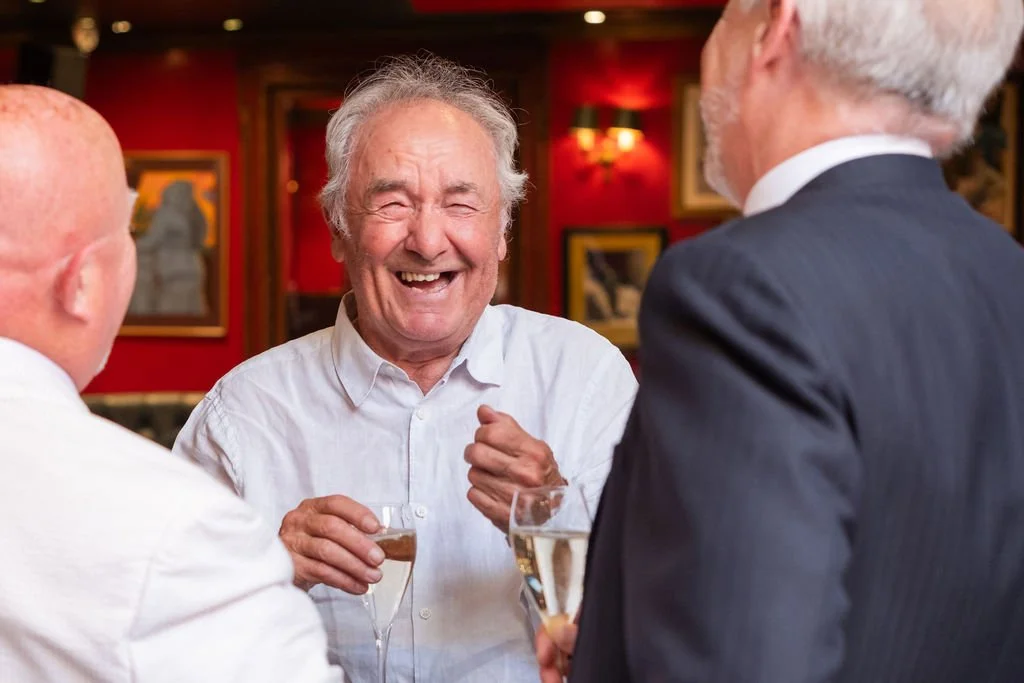
Above: Peter McKay, author of Inside Private Eye (published in 1986), at the Forest annual lunch in 2025. McKay wrote for the Eye in the pre-Hislop era. For 30 years he has worked for the Daily Mail where he currently co-edits the Ephraim Hardcastle column.
