
Certified
Don’t you just hate it when someone, usually your other half, says, out of the blue, “I need your birth certificate. Where is it?”, and you have to confess you have no idea.
Thankfully, that question proved redundant yesterday because after looking under the bed it turned out that my wife has a file where she keeps important documents (including some of mine) so I didn’t have to spend all day unpacking the many boxes I keep in the garage which are difficult to access because of all the other clutter that has accumulated in the three years since I last hired a skip.
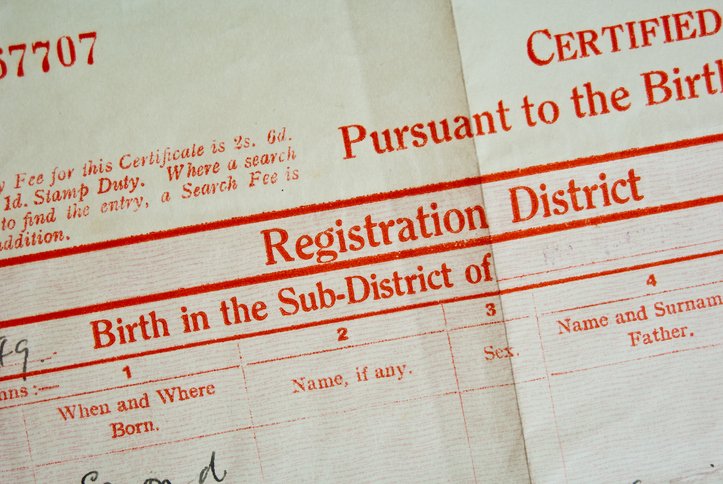
Anyway, it was interesting to be reunited with my certificate of birth, which I haven’t seen for years, because it confirmed what my mother told me a few years ago when she insisted that I was born not at St Thomas’s Hospital in central London but at Lambeth Hospital just up the road.
That came as a surprise to me because I had always believed that I was born at St Thomas’, but my birth certificate confirms that I was born at Lambeth Hospital which is not to be confused with the current psychiatric hospital that bears the same name.
The original Lambeth Hospital did in fact become part of the St Thomas' Hospital Group before closing in 1976, but in 1959 (the year I was born) it was part of the Lambeth Group of hospitals so I’m not sure how the confusion arose. Perhaps it was because my Uncle Roy (my mother’s brother) worked as a junior doctor at St Thomas’ in the Fifties.
The other bit of information that interested me was my parents’ address at the time of my birth. I knew they were renting a three-bedroom house in Harlington near Hayes in west London (where my father worked at the Nestlé chocolate factory), but until yesterday I didn’t know the address - and now I do because it’s written on the certificate in spidery black ink.
I have a vague memory of the house - where I spent my first four years - and I can confidently say it was a fairly typical 1930s suburban semi-detached home with bay windows set back from the main road by a service (or access) road that ran parallel to what I now know to be Harlington High Street.
Heathrow Airport is a little over two miles away which immediately suggests aircraft flying low overhead every few minutes, but in 1959 it was still called London Airport and there was just one terminal (the Europa Building, which was later renamed Terminal 2) with between 225 and 325 flights a day, depending on the time of year. Today there are four active terminals (2, 3, 4 and 5) that, combined, handle around 1,300 flights each day.
Likewise, while the annual number of passengers in 1959 was 5.5 million, today it’s 85 million. (The discrepancy with the growth in the number of flights, albeit still substantial, is an indication of how much larger commercial airliners are today.) As for travelling to the airport, there was no motorway or rapid rail links in 1959. Instead people went by car, coach or taxi via local roads.
Anyway, we left all that behind in 1963 when we moved to Maidenhead in Berkshire after my parents bought their first house for £3,000. They moved there because, when the first stage of the M4 motorway was built in the early Sixties, it initially went out to Maidenhead, before extending to south Wales in the latter part of the decade, which made commuting to Hayes, where my father was still working, relatively easy.
Harlington, meanwhile, suffered a double whammy - the arrival of the M4, whose construction resulted in the High Street being sliced in half, plus an expanding London Airport (which was renamed Heathrow in 1966). Today Harlington is reported to be one of five areas west of London that suffer the worst of the noise ‘because they sit under low departures and arrivals’, and that’s before the construction of a third runway. For that reason alone, I’m very glad I no longer live there!
Credit: iStock / stu49
