Save our pubs but don’t mention the war (on smoking)
Campaigns to save the ‘great’ British pub are nothing new. I can think of several over the years, and here we are again.
This week the Telegraph launched its ‘Save the Pub’ campaign with a flurry of articles, including ‘Badenoch: My blueprint to save Britain’s pubs’. Separately, the Conservatives are inviting people to sign a petition to ‘Protect Our Pubs’.
The issues that have brought the plight of pubs to a head in 2026 are high business rates and spiralling energy costs. Yesterday, the Government acknowledged the former by announcing plans to ‘water down’ the business rate rise for pubs.
Newspapers have described this as both a ‘u-turn’ and a ‘lifeline’ for Britain’s pubs. However, the Government is also, and inexplicably, considering a change to the drink-drive law in England that would bring it in line with Scotland where even a single pint of beer or glass of wine can take you over the limit, and if you can’t have a single alcoholic drink when you go to the pub why would you go at all?
It’s worth noting, of course, that the number of pubs in Britain has been falling for more than half a century, a trend that began when the increasing prevalence and popularity of television changed people’s habits and encouraged millions to stay at home in the evenings.
Over the years there have been other social changes, including increased prosperity, that have led, for example, to the introduction of gastro pubs that bear little relation to the old back street boozer.
Nevertheless, while the number of pubs fell steadily for decades, it took the introduction of the smoking ban in Scotland in 2006, followed by England, Wales and Northern Ireland in 2007, to accelerate that long-term trend.
Within ten years, according to official industry figures acquired (and paid for!) by Forest, almost 20 per cent of the pub estate in England in 2007 had closed, with evidence suggesting that 10,500 out of 50,000 pubs had gone out of business. In Wales over 860 pubs closed in the decade after the introduction of the smoking ban, approximately 21 per cent of the pub estate in 2007.
How many of those closures were a direct result of the ban we will never know because successive governments (Labour and Conservative) refused to conduct a review that took into account the impact on stakeholders such as customers and licensees (many of whom were no longer in business).
There was evidence however from Ireland, Scotland and England that, in the twelve months following the introduction of smoking bans in those countries (which happened in 2004, 2006, and 2007 respectively), there was a significant spike in pub closures which suggested a clear causal link.
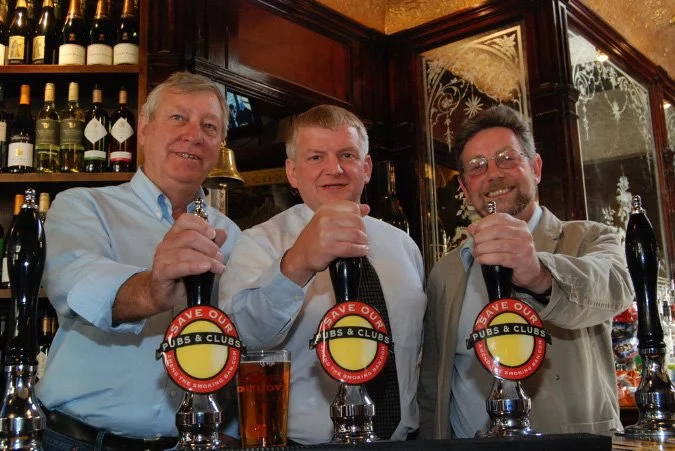
Essex publicans at the launch of the Save Our Pubs & Clubs campaign in 2009
Anyway, the Telegraph’s Save Our Pubs campaign brings to mind a similar campaign – Save Our Pubs & Clubs – that was launched by Forest in 2009 with two goals: one, to oppose calls to extend the ban to pub doorways and beer gardens; and two, to urge the government to amend the ban to allow separate smoking rooms at the discretion of the landlord.
We won the first battle (which was a genuine threat at the time) but lost the second, despite a significant number of Conservative MPs voting for a private member’s bill that would have amended the ban as we suggested.
As the name of our campaign indicated, it wasn’t only pubs we were concerned about, it was also private members’ clubs, including working men’s clubs. Like pubs, many working men’s clubs closed in the wake of the smoking ban, which was ironic given the fact that many were in constituencies held by Labour MPs whose own government had defied the party’s 2005 election manifesto and introduced a comprehensive ban with no exemptions for private members’ clubs and pubs that didn’t serve food.
Many inner-city pubs also struggled to survive or went out of business, partly because they didn’t have an outdoor space where smokers could light up in relative comfort. It was clear, and had been for several years, that Labour had moved away from its working class roots and had no interest in supporting the traditional British pub or working men’s club.
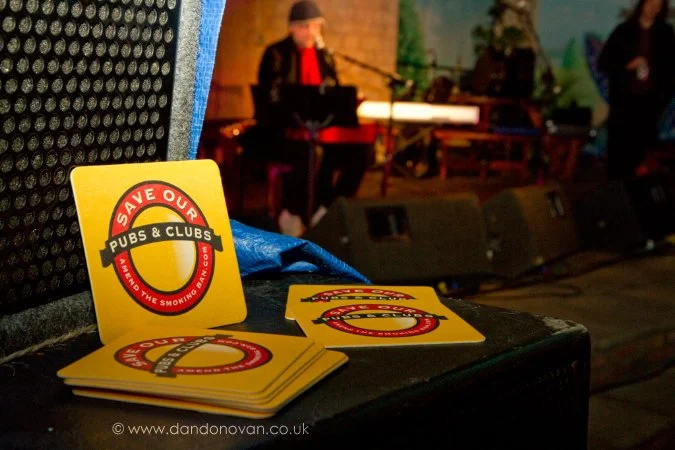
Events in support of the Save Our Pubs & Clubs campaign included gigs at pubs in Lincoln (above) and London
Speakers at the launch of the Save Our Pubs & Club campaign included TV chef and restaurateur Antony Worrall Thompson, and a certain Nigel Farage. The campaign ran for two years and included a reception on the terrace at the House of Commons when our guest speaker was the great David Hockney.
Sadly, even with Farage in Number 10, it’s probably too late for the smoking ban to be amended to permit the designated smoking rooms we were campaigning for. I say that because almost 20 years have passed since the ban was introduced and not only have most pub-going smokers adapted to the ban, a new generation has grown up with little or no exposure to tobacco smoke indoors, and I suspect that most (not all) would choose to keep it that way because, if you believe the propaganda, most pubs prior to the smoking ban were thick with tobacco smoke, which is far from the case.
Also, with the number of smokers continuing to fall, accommodating smokers indoors may not be as important to pubs as it once was (although that should be a matter for the proprietor not the state). In 2007, 24 per cent of adults in Britain were smokers. Today it’s half that. Nevertheless, smoking areas remain popular so I’d wager a bet that the percentage of pub goers who smoke is still substantially higher, especially if you include occasional smokers.
Nevertheless it annoys me that very few ‘save the pub’ campaigners ever mention the smoking ban as a factor in the decline of the British pub in the 21st century. I don’t know why that is, but I suspect it reflects an anti-smoking bias even within the hospitality industry.
The reason it’s important is that the ban was an attack on the rights of publicans to choose their own policy on smoking, independent of government, and while I accept the need for health and safety regulations to protect members of the public from significant harm, the evidence that passive smoking is harmful to non-smokers remains weak and unproven.
Unfortunately almost no-one – least of all government and the hospitality industry – wants to have that debate again, and there’s very little we can do about it. Instead we face other battles, notably the threat to ban smoking in licenced pavement areas, and even beer gardens. The latter plan may have been dropped by the current Government but it hasn’t gone away and if ministers can reduce the drink-drive limit to almost zero they can ban smoking in beer gardens.
See also: The Road To Ruin: The impact of the smoking ban on pubs and personal choice (Rob Lyons, June 2017)